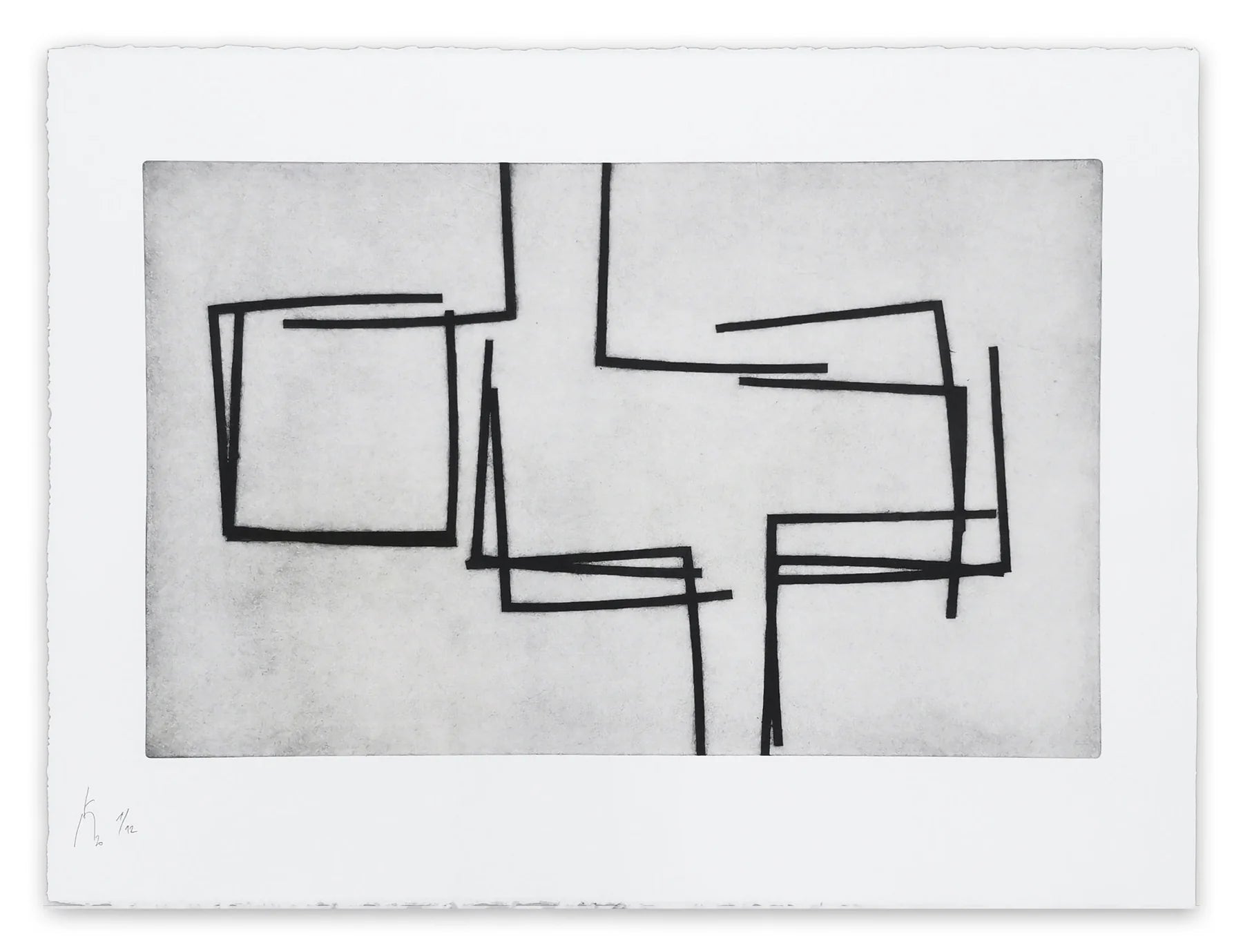
When Art Leaves the Frame: The Nobility of the Artist's Object
How rugs, folding screens, ceramics and tapestries by major artists became museum-grade collectibles, and what to know before bringing one home.
In 1911, Sonia Delaunay stitched a patchwork blanket for her newborn son's crib. Drawing on the quilts she remembered from Ukrainian peasant homes of her childhood, she assembled scraps of fabric into uneven blocks of pink, cream, green and maroon. The result was so striking that she later had it framed and exhibited under the title Couverture de berceau. The little blanket marked her decisive turn from figuration to abstraction, and it foreshadowed the work she and Robert would soon develop together as Orphism, a movement christened by Apollinaire and built on the rhythmic interplay of pure colour. The humble, utilitarian object had pointed the way to an entirely new pictorial language, years before Kazimir Malevich painted his famous Black Square.

Sonia Delaunay - Couverture de Berceau - 1911
Decades later, in October 1958, Marc Chagall was staying with friends near Lake Geneva. In their home stood a remarkable folding screen by Pierre Bonnard, Promenade des nourrices, frise des fiacres (1894-97), a four-panel lithograph in five colours, a Nabi-period masterpiece. For several days, Chagall lived alongside the piece. The artwork was no longer a flat window bolted to a wall: it folded, it stood on its own, it divided the space. Fascinated by this porosity between pure art and domestic furniture, Chagall began conceiving a folding screen of his own. It would take him almost five years of careful work to bring it to life, completed in lithograph in 1963.

Marc Chagall - Paravent - 1963
Yet despite these foundational moments, the history of art has long carried a persistent hierarchical reflex: the strict separation between the "Fine Arts" (painting, sculpture, architecture) and the "Applied Arts" (furniture, rugs, ceramics, jewellery). For a long time, the moment an artwork became useful, the market relegated it to the diminished status of "craft" or "spin-off merchandise".
But this hierarchy is an academic construct. The artist's object is not a commercial dilution of the canvas. It is proof that creation constantly seeks to escape the tyranny of the frame and inhabit the physical, everyday world.
The Bauhaus Rebellion: When Furniture Became Fine Art
The deliberate destruction of the boundary between art and object was officially codified in 1919. In Weimar, Germany, the architect Walter Gropius published the founding manifesto of the Bauhaus school, declaring: "Let us create a new guild of craftsmen, without the class distinctions which raise an arrogant barrier between craftsman and artist."
For the Bauhaus, and for the Russian Constructivists (such as Lyubov Popova and Varvara Stepanova) working around the same time, the separation between art and craft was a bourgeois, decadent concept. Their philosophical goal was to fundamentally change society. To do this, art could not remain confined to the silent, sterile halls of museums: it had to infuse everyday life. Designing a chair, a teapot, a tapestry or a textile pattern with the same geometric and conceptual rigour as a painting was, for them, the supreme artistic act. It was the pursuit of the Gesamtkunstwerk, the "total artwork" Anni Albers - Black-White-Yellow (detail) - 1926
Through artists like Anni Albers, weaving and textile design were elevated from "women's domestic work" to a rigorous, avant-garde art form, proving that the loom could be just as intellectually demanding as the easel.
The Post-War Playground: Picasso's Ceramics and Calder's Tapestries
Following World War II, some of the twentieth century's greatest masters turned to utilitarian objects not always out of ideological duty, but out of a sheer, playful hunger to explore new materials.
In July 1946, Pablo Picasso visited the Madoura pottery workshop in Vallauris, in the South of France, where Suzanne and Georges Ramié welcomed him. He produced three small pieces, returned the following summer, and from 1947 began a relentless ceramic adventure that would yield more than 3,500 catalogued editions over the next two decades. He was not just dabbling in Sunday pottery: he was subverting the medium, painting faces on plates so that the three-dimensional curve of the clay became the cheekbone of a minotaur or a woman. For Picasso, ceramics offered a way to bring his art into kitchens and dining rooms, and a tactile joy as well, a way to literally get his hands dirty.
 Pablo Picasso working at the Madoura workshop in Vallauris around 1948
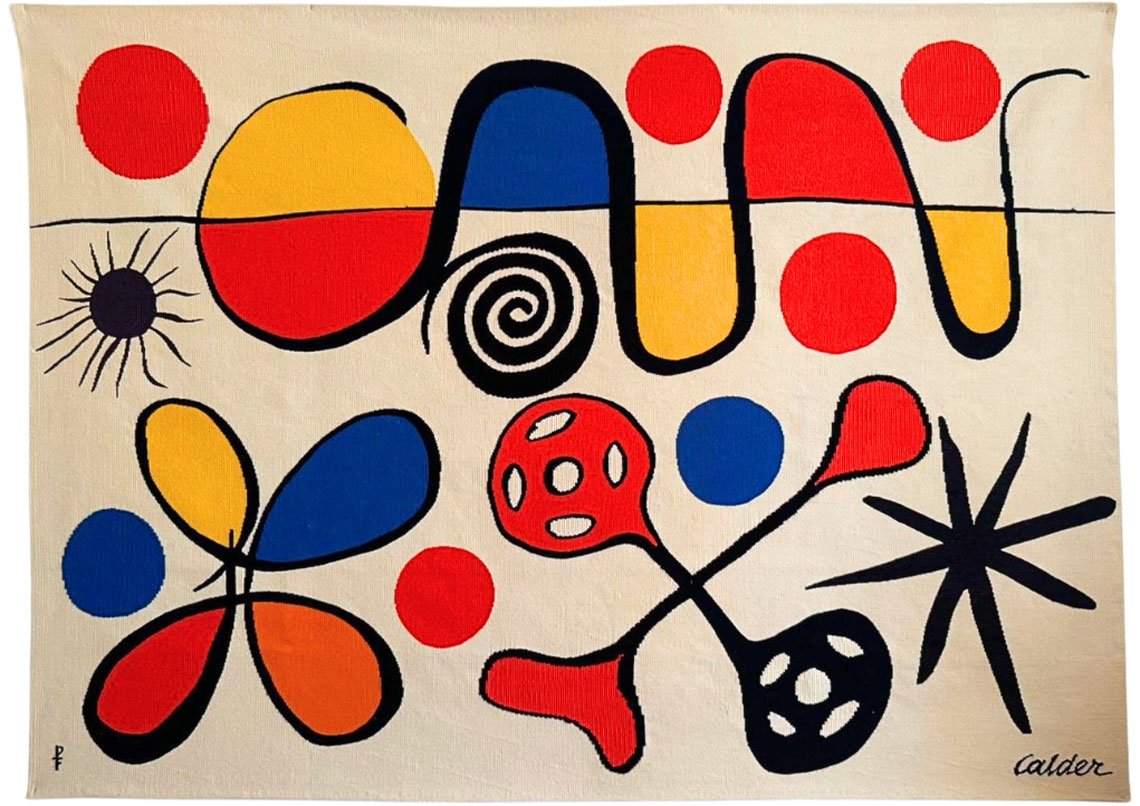
Similarly, Alexander Calder, the great kinetic sculptor, did not just make mobiles. He famously designed intricate, avant-garde jewellery from hammered brass and silver wire, and he collaborated with master weavers, including at Aubusson and later in Nicaragua, to translate his bold, primary-coloured geometries into monumental tapestries and rugs.
The architect Le Corbusier championed this specific medium, coining the brilliant neologism Muralnomad in 1949. He argued that in the modern era of cold, acoustic concrete architecture, tapestries were the perfect art form: they provided warmth, absorbed sound, and could be rolled up and carried to a new apartment under one's arm. Aubusson, in central France, became the workshop where Le Corbusier, Lurçat, Mathieu, Soulages and many others entrusted their painted cartoons to the master weavers.

Le Corbusier - Le Canapé II (Aubusson Tapestry) - 1956
Contemporary Masters: From Grayson Perry's Ceramics to Kusama's Designer Objects
Today, the line between art, craft and commercial object is more blurred, and more fascinating, than ever.
On one end of the spectrum, some artists use the object to elevate "craft" back to the summit of High Art. In 2003, Sir Grayson Perry , the British artist, shocked the traditional establishment by winning the prestigious Turner Prize. His medium? Glazed ceramic vases. At first glance they looked like classical, decorative urns, but on closer inspection they were covered in dark, satirical and deeply personal imagery. Perry single-handedly proved that a pot could carry as much conceptual weight as a Renaissance oil painting.
 Grayson Perry - Gilbert and Georges in China - 1993 (one of the Turner Prize 2003 ceramic vases)
The American artist Sheila Hicks has spent decades doing the same for textiles, creating monumental, cascading sculptures out of raw yarn and thread, proving that fibre is as noble a sculptural material as bronze or marble.

Lignes de Vie - Sheila Hicks exhibition at at Centre Pompidou - 2018
On the other end of the spectrum, contemporary art has fully embraced the "super-brand" collaboration, where utilitarian objects become vehicles for global commercial reach. Yayoi Kusama has plastered her hallucinatory polka dots across Louis Vuitton handbags. Takashi Murakami and Damien Hirst have designed limited-edition skateboards. Ai Weiwei has designed limited edition rugs.

These two registers, the High Craft revival and the super-brand strategy, are less opposed than they seem: both insist that the artistic gesture can and should escape the wall and circulate through everyday life. Is this selling out, or is it the ultimate realization of Andy Warhol's famous dictum: "Good business is the best art"? For these artists, the limited edition object, whether a £10,000 hand-tufted rug or a £100 skateboard, is a way to infiltrate pop culture completely, ensuring their visual language exists in the streets, the living rooms and the wardrobes of the world, not just in bank vaults.
From Canvas to Rug: The Art of Polysensory Translation
Whether an artist is designing a one-off folding screen or authorizing a limited edition rug, a philosophical question arises: is a reproduction still art?
Transposing an abstract painting onto a hand-knotted wool rug, for instance, is not a simple photocopy. It is an act of polysensory translation. The flat, glossy colours of acrylic paint become thick, matte fibres. The razor-sharp edge of a geometric shape becomes a tactile weave that catches the light differently depending on the direction of the pile. The artwork gains a new dimension: weight, warmth, acoustics, texture.

Rug design - Inspired by Lin X by Guillaume Moschini
It requires the intervention of a master artisan, a weaver, a foundry worker, a ceramicist, to translate the artist's conceptual vision into physical reality. This collaboration in no way diminishes the artist's authorship: rather, it celebrates the dialogue between pure idea and material mastery.
Living With Art: The Home as Immersive Installation
Historically, the "White Cube", that gallery with immaculate white walls, taught us to look at art from a distance, hands clasped firmly behind our backs, in religious silence.
The artist's object dissolves this cold boundary. It reintroduces touch, use and intimacy. Collecting a limited edition tapestry, a sculptural lamp or a painted folding screen is not lowering art to the level of furniture. On the contrary, it is elevating the domestic space to the rank of an immersive installation. It is a refusal to merely look at the painting, and a bold choice to live inside it.

Haïkus - Folding Screen by IdeelArt Editions - 2026 - Available soon on IdeelArt
FAQ: Limited Editions, Multiples and Artist's Objects
1. What is the difference between an art reproduction and an original artist's edition?
A reproduction (such as a museum poster or an industrial print) is a simple mechanical copy of an existing work, without direct intervention or control by the artist, and whose value is purely decorative. An original edition (or a multiple), on the other hand, is a project conceived, approved and controlled by the artist or their estate. Whether it is a lithograph, a bronze cast in an edition of eight, or a rug woven in a limited series of twenty, the edition is numbered, limited in quantity, and accompanied by a certificate of authenticity. It holds true secondary value on the art market.
2. Are limited editions more expensive than open editions, and why?
Yes, limited editions are almost always more expensive than open editions, sometimes by an order of magnitude, and the reason is straightforward: scarcity creates value. A limited edition is capped at a fixed number of copies (often 8, 20, 50 or 100), after which the printing plates, weaving cartoons or moulds are destroyed or formally retired. The artist invests deep personal control over each proof and each finished piece, and the work is accompanied by a certificate of authenticity, a signed and numbered inscription, and full provenance documentation. An open edition has no such cap, may be reprinted indefinitely on demand, involves less artist supervision, and carries no resale value on the secondary market. In short, you are paying for rarity, authorship, and the institutional credibility that comes with both.
3. Why does the edition number (for example 4 of 20) matter?
The edition number tells you exactly how rare the piece is and confirms its place in a controlled series. The lower the total edition (the denominator), the more valuable each piece tends to be on the long term. Some collectors also pay attention to the position in the series (the numerator), although in modern editions all proofs are produced to the same standard. What matters most is that the number is accompanied by the artist's signature and a matching certificate of authenticity.
4. What is a certificate of authenticity, and why is it essential?
A certificate of authenticity (COA) is the official document that proves a work is an original artist's edition. It includes the title, year, medium, dimensions, edition size, edition number, the artist's signature or that of their estate, and the issuing gallery or studio. Without a COA, the work loses its market value and may be questioned by future buyers, insurers and auction houses. For any edition above a modest price point, the COA is as important as the piece itself.
5. How can you authenticate an artist's rug, folding screen or ceramic edition?
Authentication relies on a chain of verifiable elements: the artist's signature on or attached to the piece, the edition number, the certificate of authenticity, the gallery or workshop provenance, and ideally an entry in a catalogue raisonné or a published edition register. Reputable galleries also keep production photographs, weaving cartoons or original drawings on file. For high-value secondary market acquisitions, expert authentication services exist for specific artists or estates.
6. Are artist rugs and limited edition art objects a good investment?
Yes, historically the art market highly values utilitarian objects created by major artists. Tapestries by Alexander Calder, ceramics by Pablo Picasso, jewellery designed by Salvador Dalí and folding screens from the Nabis period are actively traded today in major auction houses. A contemporary artist's limited edition rug or design object produced in a strict, small series is considered a work of art in its own right, and its financial value often evolves in parallel with the artist's primary pictorial value. That said, art investment requires the same long-term horizon as any cultural asset.
7. Can a limited edition artwork appreciate in value over time?
Yes, and many do. The factors that drive appreciation are: the rising market reputation of the artist, the rarity of the specific edition, the historical importance of the series, the quality of preservation, and provenance documentation. Editions tied to important exhibitions or career milestones often appreciate faster. Conversely, an edition without a clear COA or with damaged provenance rarely appreciates, regardless of the artist.
8. What is the role of the artisan (weaver, ceramicist, foundry) in creating an artist's object?
Art history is fundamentally collaborative. Just as a sculptor like Auguste Rodin did not cast his own bronzes but worked with a master foundry, a painter who designs a rug works with a licier (master weaver). The artisan brings exceptional technical expertise to translate the artist's conceptual vision into the material. The artist approves the proofs and the final piece. This collaboration is an accepted and celebrated part of the art world ecosystem, and in no way diminishes the artist's authorship.
9. How does the medium (texture of a rug, relief of a folding screen) modify the perception of an abstract artwork?
The change of medium transforms the artwork's behaviour. A geometric abstract painting on canvas often plays on flatness and optical illusion. Transposed onto a rug, the same geometry acquires thickness and a texture that absorbs light unevenly. On a folding screen, the artwork becomes three-dimensional and kinetic: colours and shapes respond differently depending on how the panels are angled and how the viewer moves through the room. The object demands physical interaction in a way the canvas does not.
10. What materials are typically used in fine art rugs and tapestries?
Fine art rugs are most commonly produced in pure wool, in wool and viscose blends (often 70/30), or, for the highest end pieces, in wool and silk. New Zealand wool is favoured for its long fibres, lustre and durability. The backing is typically cotton. For tapestries woven at Aubusson and similar workshops, hand-spun wool and silk are dyed to the artist's specification before being woven on traditional looms. The materials are chosen both for visual fidelity to the artist's intention and for long-term durability.
11. What is the difference between hand-knotted, hand-tufted and machine-made art rugs?
A hand-knotted rug is produced one knot at a time by skilled artisans on a vertical loom, often requiring months of work, and is the most prestigious and durable technique. A hand-tufted rug is made by punching yarn through a stretched canvas backing with a tufting gun, then finishing the back with a secondary layer; production is faster, the technique allows great design freedom, and quality can be excellent. A machine-made rug is industrially produced, has no artist supervision, and is not considered a fine art edition. Most contemporary artist editions are hand-tufted or, more rarely, hand-knotted depending on design complexity and price point.
12. How long does it take to produce a hand-tufted art rug or a lithographic folding screen?
A hand-tufted art rug of around 250 by 300 centimetres typically takes between six and twelve weeks of production, plus design, sampling and quality control. A hand-knotted rug of comparable size can require six months or more. A lithographic folding screen involves cartoon preparation, plate creation, multi-pass printing in successive colours, mounting on wooden panels and final assembly. Chagall's 1963 screen took five years from inspiration to finished piece, which is exceptional, but a contemporary artist's screen often requires twelve to eighteen months from concept to delivery.
13. Can you use an artist's rug as a regular floor rug at home?
Yes, artist's rugs are designed to be lived with. The choice depends on traffic and personal use. In a low-traffic area such as a bedroom, study or formal sitting room, a fine art rug can serve its full decorative and tactile function without significant wear. In high-traffic zones such as entryways or main living rooms, many collectors rotate placement seasonally, or alternate between floor display and wall hanging. The piece remains part of daily life while being preserved for the long term.
14. How should I display an artist's folding screen in a contemporary interior?
A folding screen works in three modes. As a room divider, it organises open-plan spaces and creates visual zones without permanent partitions. As a wall presence, partially unfolded against a flat wall, it becomes a sculptural relief artwork. As a standalone sculpture, fully open in the middle of a room, it commands the space like an installation. Vary the angle of the panels to play with light and perspective. Allow at least one to two metres of viewing distance for the piece to read fully.
15. What are the conservation criteria for collecting utilitarian artworks at home?
These objects are made to be lived with, but a few simple precautions keep them in excellent condition over decades. The main enemy is direct sunlight (UV rays), which can alter the pigments of a painted screen or fade the dyes of a wool or silk rug over time. Humidity should be moderated, ideally kept between 40 and 60 percent. Wool rugs benefit from gentle vacuuming without a beater bar, and occasional professional cleaning every few years. Folding screens should be stored or displayed away from radiators and high humidity sources.
16. Can I commission an artist directly for a custom edition?
Yes, although the process depends on the artist and the gallery representing them. Some artists welcome direct commissions for limited editions of rugs, tapestries or sculptural objects, particularly when the project aligns with their current research. Others work exclusively through their gallery or estate. A commissioned edition typically involves a proposal phase, design proofs, contractual agreement on edition size and pricing, and a longer production timeline. Feel free to get in touch if you are interested in hearing more about our artists' rugs and folding screens.
17. Are limited edition art objects a meaningful gift for collectors or design enthusiasts?
Yes, and they have become increasingly popular for major life events, corporate gifting and milestone celebrations. A signed and numbered edition offers the cultural credibility of fine art, the daily presence of a beautiful object, and a verifiable market value. The combination is rare. For first-time recipients, smaller editions such as lithographs, ceramics or signed prints are an accessible entry point. For experienced collectors, rugs, tapestries and sculptural editions create lasting impact.
18. Is buying art editions online safe and reliable?
Yes, provided the gallery is established and transparent. Look for clear provenance, full edition information (title, year, medium, dimensions, edition size), a published certificate of authenticity policy, secure payment, professional shipping with insurance, and a return policy. Reputable online galleries publish artist biographies, exhibition histories and high resolution images. Customer service should be reachable and responsive. The convenience of online acquisition has become standard practice for collectors at all levels, including for high-value editions.
By Francis Berthomier
All images © The Artists