Joanne Freeman Interview
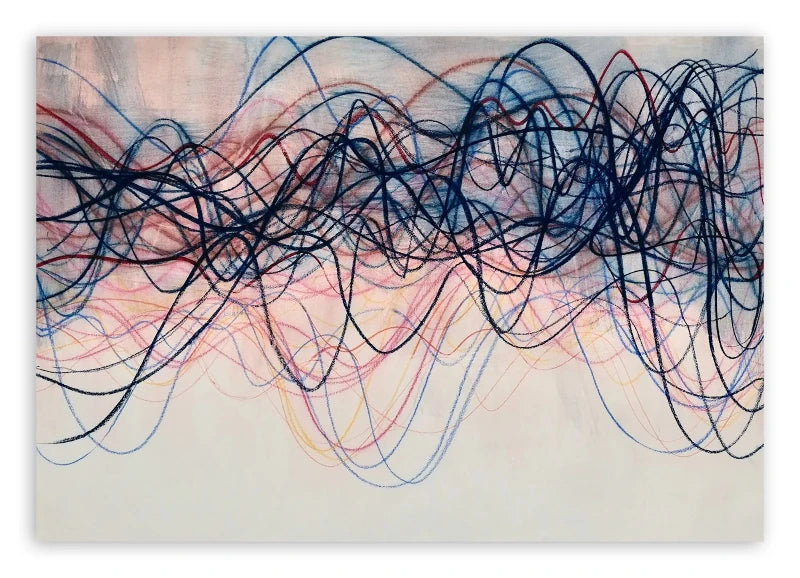
Elegant white canvases embellished with only a few carefully designed loops of different colors, exuding a certain rhythm of peacefulness and harmony. The less-is-more principle is evident in the works of Joanne Freeman. With only a few effective lines, she manages to build an impactful vision and captivate the viewer. IdeelArt had a unique opportunity to ask Joanne Freeman a few questions about her work, creative process and life as an artist. We discussed her thoughts on her work, how she perceives the relationship between the creator and the art, and between the art and the viewer. So, enjoy our short, but insightful, interview with the very lovely Joanne Freeman.
You’ve attended college in Madison, Wisconsin, lectured in Massachusetts, exhibited widely across the US and internationally, and you live and work in New York City. Can you talk about the ways that your work is informed by a sense of place?
My work is strongly influenced by place. As mentioned, I live and work in New York City, and that visual and cultural climate has a strong impact on my work. I’m always surprised when I leave and re-enter, by what I notice. The time away, always gives me a revived perspective and a freshness of sight. Travel does the same thing, when in a different environment I’m open to things others may find mundane through familiarity. I can recount many of the influences on the work, sometimes directly as I’m creating it and sometimes way after the fact when I’m viewing it.
How is your work influenced by your own physicality?
My process in the studio is physically strenuous, especially as the scale of the paintings increase. The hard edge lines in the paintings are made by the sweep of my arm from one edge of the canvas to the other. The size of both the external supports and interior lines are relative to both the process and the proportions of my body.
You sometimes work on round surfaces. Considering the physical nature of the gestures you make, how does your connection with the surface evolve when confronted with circular space?
The gestures do become more contained and controlled when paired with circular space. They are more deliberate revolving and mimicking the circular shape of the canvas. Where in the larger rectangular paintings I execute grand sweeps that run off the edges and suggest infinity, the circular pieces center in on themselves, accentuating the shape and edge of the surface, which contributes to objectifying the painting.
Some of the work you make involves limiting your access to the surface by taping areas off. How does your emotional/intellectual state vary when you confront a work like that, as opposed to when you have complete freedom to access the entire surface?
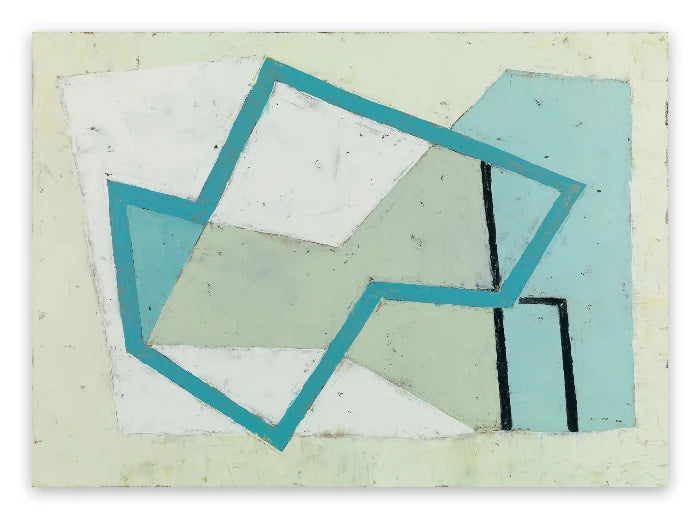
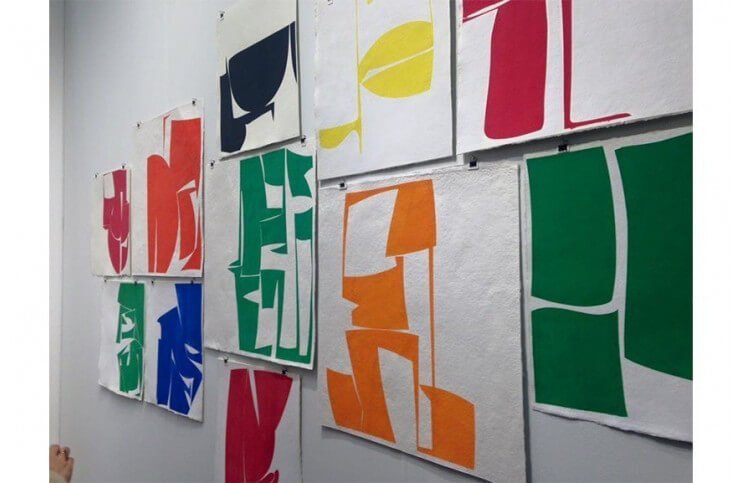
I think you are referring to my works on paper where I tape off areas and create shapes of color, versus my paintings, which seem more open ended. The process is actually quite similar between the two mediums and is actually quite intuitive. I place either a line or a shape on the surface and build off of it. With the paintings the composition is more fixed and my options have to do more with color choices. The monochromatic color I use in the drawings allow me to play more with composition. Either way I’ve pared down the language, set boundaries and limited my choices, which paradoxically allows for more freedom.
You’ve mentioned being influenced by the work of Reductive artists. Could you name a few of the artists whose work you admire, and talk about the questions they’ve helped you find or answer.
I look at a lot of artists work, some that come to mind are: Paul Feeley, Morris Louis, Kenneth Noland, Mary Heilmann, Carla Accardi and Ellsworth Kelly. I admire the work of artists whose works appears minimal and monumental, but at the same time celebrates the handmade and whimsical. It is a bit of a Catch-22, the process of reductive painting, because you have to go through a lot of work and overkill to reach a simple honest statement. I question my reactions to my predecessors work, and try to find the confidence to say more with less.
What do you experience intellectually during the physical act of reductive image making?
I try to act reflexively in the studio by controlling critical assessments and attempting to make judgments viscerally, based on the information in front of me. The canonization of artists and the powerful influences of art history can lead to a situation described to me as the Mona Lisa syndrome, where the mythology of a work overshadows an honest reaction to it. I’ve internalized a reductive visual language that works for me based on its art historical precedents; Russian Constructivism, The Bauhaus School, Neo-Plasticism, and less obvious, the early Christian art of Giotto, and Fra Angelico, at the Convent of San Marco. These teachings along with the influences of more contemporary artists are always with me in the studio. Hopefully this learnt common language leads to a unique interpretation.
What do you hope the viewer will experience when encountering your work?
Strangely because I’m so involved with the process of creating my work, I can have trouble actually seeing it in the moment. I’ve had the experience of seeing my work a few years down the line in someone else’s home or in the context of a different institution. In that moment it is always nice to think, “ oh wow that works”. I would hope the same for a viewer.

Joanne Freeman
Featured image: Photograph taken of Joanne Freeman's ''Covers'' series at Art on Paper, Kathryn Markel booth, Pier 36, New York, NY. March 4th-6th - Courtesy of the artist