When Hilla Rebay Became the Guiding Spirit of the Guggenheim Museum
Hilla Rebay helped shape one of the most influential institutions in the history of abstract art. An artist, collector and the first director of the Museum of Non-Objective Painting, she brought together a belief in the spiritual potential of abstraction and a determination to share it with the public. Her partnership with Solomon R. Guggenheim helped build the collection and establish the institution that became the Solomon R. Guggenheim Museum. Understanding her contribution means looking beyond the familiar spiral building to the artistic vision that helped bring it into being.
A Vision for Non-Objective Art
For Rebay, non-objective art was more than a departure from recognizable subjects. It was a visual language capable of expressing spiritual impulses and feelings without words. She believed that this language could transcend boundaries and encourage a more harmonious world. Her vision for a museum was correspondingly ambitious: not simply a place to store and display paintings, but an environment for contemplation.
Her ideas were shaped by her encounters with the European avant-garde. In Zurich, Jean Arp introduced her to the writings of Wassily Kandinsky, whose account of the spiritual possibilities of abstraction became an enduring influence. In Berlin, she exhibited at Galerie Der Sturm and met Rudolf Bauer, who became her partner and a central artistic collaborator. Rebay was also an artist in her own right, working in painting and collage. Her commitment to abstraction was lived through making as well as collecting.

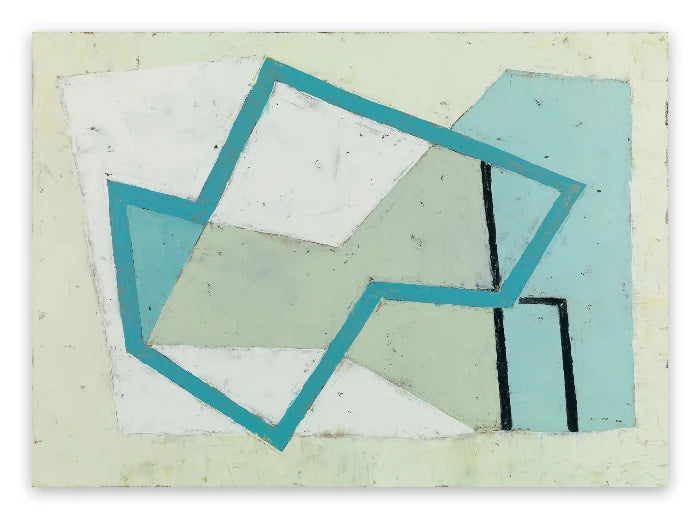
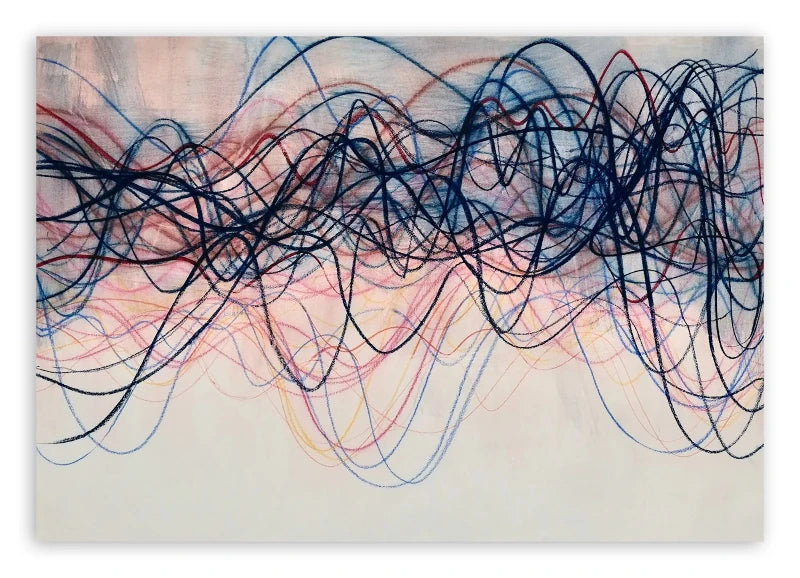
Hilla Rebay - Collage, 1917, 26.7 × 43.2 cm
The Museum of Non-Objective Painting
The Solomon R. Guggenheim Foundation was established in 1937. Two years later, the Museum of Non-Objective Painting opened in temporary quarters on East 54th Street in New York, with Rebay as its director. Designed by William Muschenheim, the gallery gave many visitors their first encounter with works by Kandinsky, Bauer and other artists associated with non-objective painting.
The atmosphere reflected Rebay's belief in a “museum-temple.” Incense filled the air, music by Johann Sebastian Bach and Ludwig van Beethoven played, and the surroundings encouraged visitors to linger. The setting was meant to support an encounter with art that was inward and contemplative, rather than merely visual. Art, spirituality and public education were inseparable parts of her project.
This approach differed sharply from Peggy Guggenheim's Art of This Century museum and gallery, which opened nearby in 1942. Both women helped make modern art visible to American audiences, but they did not share the same priorities. Rebay's uncompromising dedication to non-objective painting brought her into conflict with other approaches to modern art and with members of Solomon Guggenheim's family. Those disagreements are part of her story, but they should not obscure the scale of her achievement as a collector, organizer and museum director.

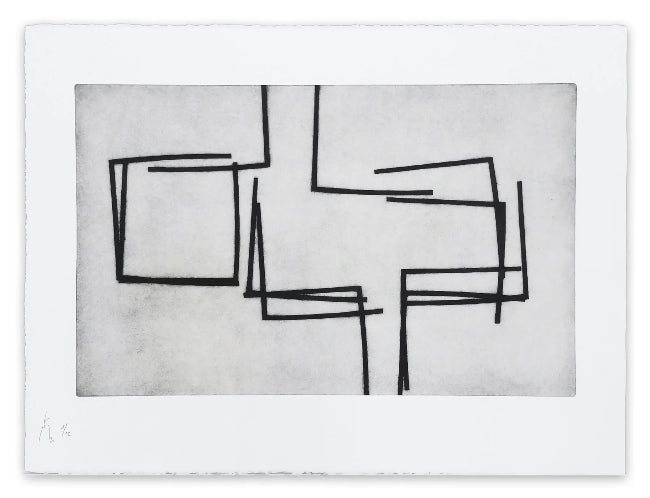
Hilla Rebay - Delicate, 1950, oil on canvas, 129.5 × 106.7 cm
A Partnership Born
Rebay immigrated to the United States in 1927 with the ambition of establishing a public gallery for non-objective art. Her decisive encounter with Solomon Guggenheim followed in the late 1920s, when he sat for a portrait in her studio. Works by Bauer hanging there caught his attention. Rebay encouraged Guggenheim to collect them, beginning a personal and professional partnership that would transform his collecting.
In 1930, Rebay traveled to Europe with Guggenheim and his wife, Irene. In Dessau, they met Kandinsky while he was teaching at the Bauhaus, and Guggenheim purchased Composition 8, painted in 1923. It became the first of more than 150 Kandinsky works that would enter the museum's holdings over the years. With Rebay's guidance, Guggenheim systematically expanded his collection of non-objective art.
Rebay's contribution extended far beyond recommending acquisitions. She organized exhibitions, lectures, loans and educational programs, helping build a public for an art that many viewers still found unfamiliar. She also helped develop the idea of a permanent museum. In 1943, Rebay and Guggenheim commissioned Frank Lloyd Wright to design it. The resulting spiral would give architectural form to their ambition for a different kind of encounter with art.

Hilla Rebay - Orange Cross, ca. 1947, oil on canvas, 112.1 × 94 cm
A Lasting Legacy
Solomon Guggenheim died in 1949. Rebay stepped down as director of the foundation and museum in 1952, seven years before Wright's building opened to the public on October 21, 1959. The Guggenheim's biography records that she continued in an advisory role as director emeritus, while painting and collecting independently.
The circumstances of her departure deserve attention as well as the dates. Drawing on biographer Joan Lukach's research, The Art Story describes mounting pressure from trustees, restrictions on Rebay's budget and a loss of support after Solomon's death. Its account states that she was not invited to the new museum's opening in 1959 and was subsequently removed from her remaining posts. Read alongside the museum's institutional history, this perspective shows how a founding figure's contribution could be celebrated in retrospect while her position within the institution became increasingly precarious.
After her death in 1967, part of Rebay's estate entered the Guggenheim's permanent collection, including works by Bauer, Alexander Calder, Albert Gleizes, Kandinsky, Paul Klee, Piet Mondrian and Kurt Schwitters. Her legacy survives not only in the museum's architecture and holdings, but in the idea that abstract art deserves a public space in which it can be experienced seriously and at length.
Remembering Hilla Rebay means recognizing an artist and advocate whose vision helped make the Guggenheim possible. Her conviction that art could change how people think and feel remains central to the history of abstraction. For a related exploration of contemplation in abstract painting, read our Ultimate Guide to Mark Rothko, which explores another artist's belief in the power of an encounter with painting.
By Phillip Barcio. Editorially updated by IdeelArt, October 2026.
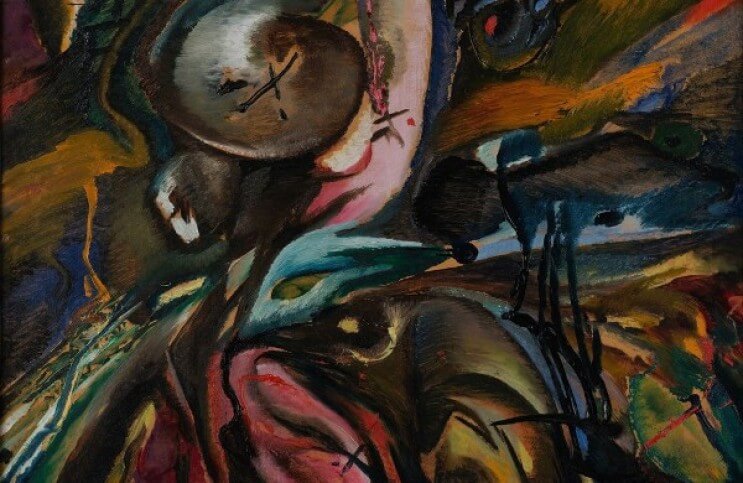
Featured image: Hilla Rebay - Composition #9 (detail), 1916, oil on panel.
Image credits: Weinstein Gallery, San Francisco, as credited in the original article. Images used for illustrative purposes.
Sources
The Art Story - Hilla Rebay: Paintings, Biography and Ideas. Independent secondary account corroborating her collecting partnership, spiritual approach to non-objective art and museum chronology, with a discussion of the pressures surrounding her departure that draws on biographer Joan Lukach's research.
Solomon R. Guggenheim Museum - Hilla Rebay. Institutional biography, artistic influences, museum leadership and legacy.
Solomon R. Guggenheim Museum - Solomon R. Guggenheim. Institutional account of his collecting history and partnership with Rebay.
Solomon R. Guggenheim Foundation - History. Foundation and museum chronology.